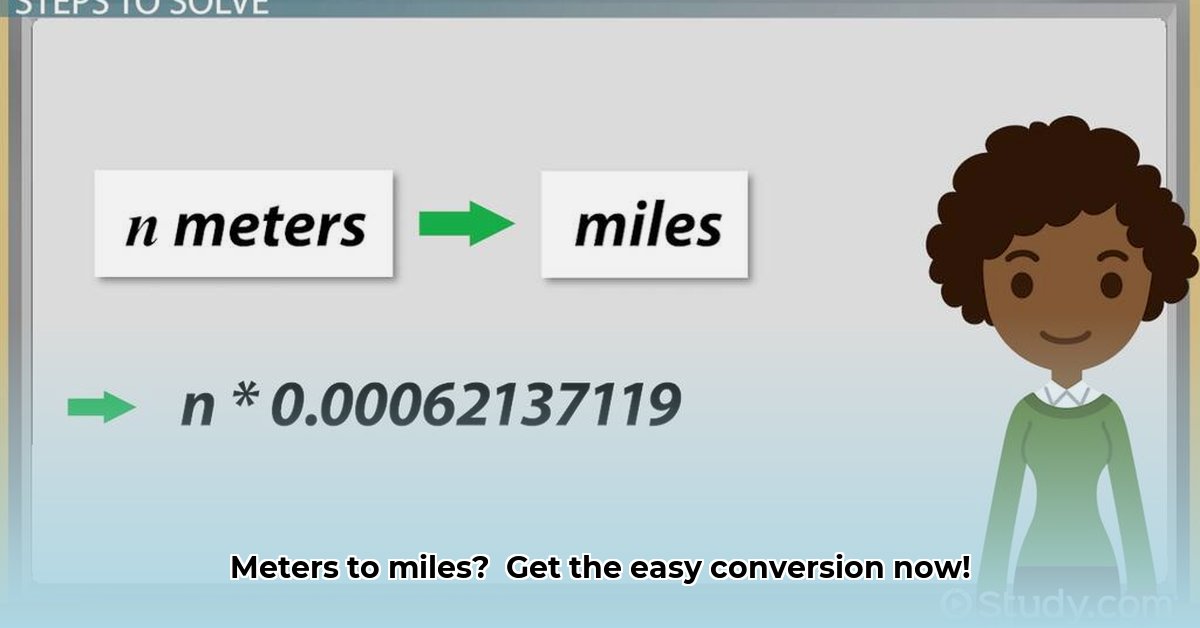
Need to quickly convert meters to miles? Whether you're planning a road trip, training for a marathon, or working on a construction project, this guide provides easy and accurate methods for converting between these units of measurement. We'll cover several approaches, from simple calculations to using convenient online tools. By the end, you'll be a meter-to-mile conversion expert! For a quick example, see this helpful conversion.
Understanding the Conversion Factor
The core of meter-to-mile conversion lies in understanding the relationship between the two units. One mile is equal to 1609.344 meters. This is the crucial conversion factor we'll use throughout this guide. Knowing this number simplifies the entire process.
Method 1: Quick Calculation
The simplest method involves direct division. Take your distance in meters and divide it by 1609.344.
- Example: You have 5000 meters. Divide 5000 by 1609.344 (5000 / 1609.344 ≈ 3.10685) which rounds to approximately 3.1 miles.
This method is ideal for quick conversions when you have a calculator handy.
Method 2: Online Converters
Numerous free online tools are specifically designed for unit conversions. Simply input your meters, and the converter instantly provides the equivalent in miles. This is a convenient option, especially if you only need to perform a few conversions. Many online converters offer high accuracy. Remember to check the source's credibility, however. Will this always give you the correct answer? It will provide a result; but you must always double check it yourself.
Method 3: Smartphone or Computer Calculator
Most smartphones and computers include built-in calculators capable of performing this conversion. Just divide the meters by 1609.344, as in Method 1. This method offers convenience and accessibility wherever you go.
Method 4: Estimation
For a rough estimate, you can round the conversion factor. Consider 1 mile as approximately 1600 meters. Dividing your meters by 1600 provides an approximate result. This method sacrifices precision for speed and is suitable when an exact figure isn't crucial.
- Example: Using 5000 meters again, 5000 / 1600 ≈ 3.125 miles. This is a reasonably close approximation.
Choosing the Best Method
The optimal approach depends on your needs. For rapid estimations, Method 4 is sufficient. For speed and accuracy, Method 2 (online converters) or Method 3 (calculator) are excellent choices. For precise calculations, Method 1 remains the most straightforward, and it allows you to control and understand the level of precision.
Troubleshooting Tips
Slight discrepancies in results may occur due to rounding. To ensure accuracy, use more decimal places in your calculations. Always double-check that you've correctly entered the initial meter value.
Key Takeaways
Converting meters to miles hinges on understanding that 1 mile ≈ 1609.344 meters. Mastering this factor empowers you to handle any conversion confidently. Now, go forth and measure!
Pivotal Points for Accurate Meter-to-Mile Conversions
- Precision Matters: The level of accuracy needed depends on the application. For critical projects like engineering or surveying, precision is paramount. For casual conversions, a rough estimate is often fine.
- Multiple Methods Available: Several methods cater to different needs and levels of technological access. Choose the method that best suits your situation and required accuracy.
- Verification is Key: Always double-check your conversions, whether using manual calculations, online tools, or calculators. Independently verifying the results using a different method assures accuracy.